 Sloth Quiz
The Bing Sloth Quiz
Sloth biology, behaviour, and surprising facts.
Think fast. Answer Smarter.
80 seconds · 10 questions · 4 options each · Static and evergreen — the same 10 questions, always available



12K+ players are playing daily
Always-On Challenge
80
Seconds
10
Questions
Evergreen
Cadence
Static and evergreen — the same 10 questions, always available
This set went live January 1, 2025
Free to Play
No hidden paywalls or premium lockouts, ever.
Top 6% "Mastermind"
Only the sharpest minds hit a perfect score today.
No Sign-Up Required
Jump straight into the quiz. Zero friction, instant play.
4.8/5 User Rating
Loved by thousands of daily trivia players worldwide.
EXPLORE MORE
Other Quiz Categories
More ways to challenge yourself and grow your knowledge. Choose a quiz and keep learning every day.
Bing Sloth Quiz
Sloth biology, behaviour, and surprising facts.
80 Sec
10 Questions
Play Quiz
Bing Daily Quiz
Fresh questions every day across six knowledge categories.
45 Sec
5 Questions
Play Quiz
Bing Homepage Quiz
One question for each day of the week's Bing Homepage.
65 Sec
7 Questions
Play Quiz
Bing Homepage Image Quiz
Study the image for 15 seconds, then answer 5 questions about it.
60 Sec
5 Questions
Play Quiz
Bing Weekly Quiz
Twelve questions. One deep weekly challenge.
150 Sec
12 Questions
Play Quiz
Bing News Quiz
Ten questions on this week's biggest headlines.
80 Sec
10 Questions
Play Quiz
Bing Entertainment Quiz
Movies, music, and pop culture await.
60 Sec
8 Questions
Play Quiz
Bing Education Quiz
Universities, educators, and how the world learns.
60 Sec
8 Questions
Play Quiz
Bing Fitness Quiz
Exercise science, nutrition, and wellness myths.
60 Sec
8 Questions
Play Quiz
Extraordinary Women Quiz
Scientists, leaders, and activists who changed the world.
60 Sec
8 Questions
Play Quiz
Bing Environment Quiz
Climate, oceans, wildlife, and the planet we share.
65 Sec
7 Questions
Play Quiz
Bing UNESCO Quiz
World Heritage Sites from every continent.
60 Sec
8 Questions
Play Quiz
Bing Social Media Quiz
Platform history, viral culture, and the creator economy.
50 Sec
6 Questions
Play Quiz
Bing Australia Quiz
Geography, wildlife, history, and famous Australians.
80 Sec
8 Questions
Play Quiz
Bing Moon Quiz
Lunar science, Apollo missions, and Moon mythology.
60 Sec
8 Questions
Play Quiz
Bing Lakes Quiz
Lake records, geography, ecology, and conservation.
80 Sec
8 Questions
Play Quiz
Bing Golf Quiz
Golf majors, legends, rules, courses, and history.
80 Sec
10 Questions
Play Quiz
Ready for Today's Challenge?
Test your knowledge across 6 exciting categories. You have 80 seconds. 10 questions. Let's go!
80
Seconds
10
Questions
6
Categories
Sloth Habitat
Sloth Behaviour
Sloth Biology
Sloth Species
Sloth Conservation
Surprising Sloth Facts
Quick Rules
- Answer all 10 questions before time runs out.
- You can go back and change answers before submitting.
- The 80-second timer starts as soon as you click Start Quiz.
New questions every day at midnight
0:80

Question 1 / 10
1. In what type of forest do most sloths live?
2. What do sloths spend most of their time doing?
3. Why do sloths move so slowly?
4. What are the two living sloth genera called?
5. What is the IUCN status of the pygmy three-toed sloth?
6. Are sloths capable swimmers despite their slow movement on land?
7. Why can some sloths turn their heads so far?
8. What mainly distinguishes two-toed from three-toed sloths?
9. Where does the critically endangered pygmy three-toed sloth live?
10. What lives permanently in the fur of sloths?
You can go back and change your answers before submitting

Well Done!
You're a Rank
Your Score
0/0
0%Correct Answers
0
Time Taken
0 s
The Sloth Quiz is always here
Come back and boost your knowledge!
ABOUT THE SLOTH QUIZ
What is the Bing Sloth Quiz?
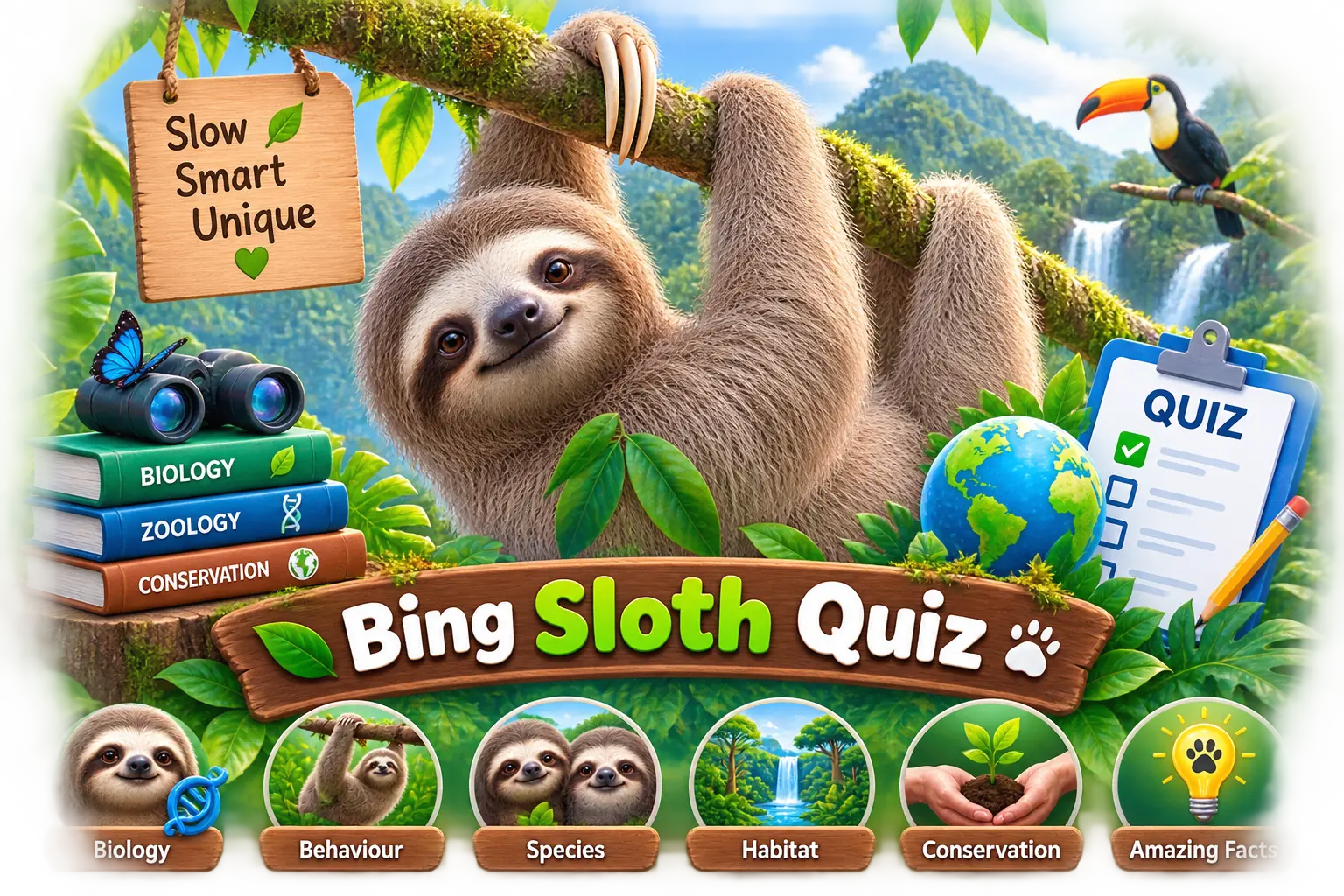
The Bing Sloth Quiz on BingQuiz.org is a wildlife trivia challenge dedicated entirely to one of the most scientifically fascinating animals on the planet. Ten questions cover sloth biology, behaviour, species, habitat, conservation, and facts that most people never knew about sloths despite finding them endlessly interesting.
The Sloth Quiz Online goes deeper than the obvious facts. Most people know sloths are slow. The quiz tests what lies underneath that, the metabolic science behind the slowness, the ecosystem living inside their fur, the six species most people cannot name, and the conservation crisis facing the rarest of them.
Every answer in the Bing Sloth Quiz is verified against the IUCN Red List and reliable zoological sources before going live. The quiz is static and evergreen, the same ten questions are always available, always playable, with full explanations after every submission.
HOW TO PLAY
How to Play the Bing Sloth Quiz
A quick, three-step format: click and begin, work through 10 questions, see how you did.
-
01
Click and Begin
Hit the Start Quiz button on the Bing Sloth Quiz. The 80 second timer kicks in, and your first question appears immediately. Unlike the animal this quiz is about, the timer does not move slowly.
-
02
Work Through the Questions
Ten questions appear one at a time on the Sloth Quiz Online. Go back to any earlier question if you want to change an answer before the timer runs out. Sloths take their time. You do not have that luxury.
-
03
See How You Did
Once you submit, your score, rank, and a detailed explanation for every answer appear on the same page of the Wildlife Quiz on BingQuiz. Even a Wanderer score comes with ten facts worth knowing.
WHAT IT COVERS
What the Bing Sloth Quiz Covers
The Bing Sloth Quiz covers six areas of sloth knowledge across its ten questions. Here is what to expect in each one before you play.
1
Sloth Biology
Questions about how the sloth body actually works. Metabolism, digestion, muscle structure, body temperature, and the physical adaptations that make sloths one of the most energy efficient mammals on the planet. These are the questions that change how you think about slowness. It is not a limitation, it is an evolutionary strategy that has worked for 60 million years.
2
Sloth Behaviour
Questions about what sloths actually do and when. Sleep patterns, the famous weekly descent to the forest floor, diet, how they move through the canopy, and the surprising things sloths can do that most people assume they cannot. Swimming is one of them.
3
Sloth Species
Questions about the six living sloth species split across two genera, two-toed and three-toed. Which species lives where, what makes each one distinct, and which name refers to which animal. Most people cannot name more than one sloth species. This category tests whether you can.
4
Sloth Habitat
Questions about where sloths live, what kind of trees they depend on, and how the Central and South American rainforest canopy shapes every aspect of sloth life. The habitat questions connect sloth biology to the ecosystem they have evolved alongside for millions of years.
5
Sloth Conservation
Questions about the threats facing sloth populations, which species are at risk, and what conservation status each species holds on the IUCN Red List. The pygmy three-toed sloth, found only on one small island off Panama, is critically endangered with fewer than 100 individuals remaining in the wild.
6
Surprising Sloth Facts
The most unexpected category on the Sloth Quiz Online. Questions about sloth facts that even dedicated animal lovers rarely know. The algae that grows in their fur. The moths that live exclusively in sloth fur. The ancient giant ground sloths the size of elephants that went extinct 10,000 years ago. The permanent smile that is actually a facial marking.
At the end of every Bing Sloth Quiz, all ten correct answers are revealed with a short explanation covering the science behind each one. Every player walks away from the Wildlife Quiz knowing something genuinely new about one of the most misunderstood animals on the planet.
THE SCIENCE
The Science Behind Sloths
Most people know sloths as the internet's favourite slow animal. The science behind them is considerably more interesting than that reputation suggests.
1
Slowness as strategy
A sloth's metabolism runs at roughly 40 to 74 percent slower than a mammal of comparable size. This is not a disadvantage. It is a survival mechanism that allows sloths to survive on a diet of leaves that provides almost no nutritional value. A single meal can take up to a month to fully digest. By moving slowly and resting up to 20 hours a day, sloths consume so little energy that their low-calorie diet is sufficient to sustain them. They have outlasted thousands of species by doing less.
2
The fur ecosystem
Sloth fur is not just fur. It hosts an entire living community. Algae grows in grooves along each hair shaft, giving the fur a greenish tint that provides natural camouflage in the canopy. Inside that fur live moths, beetles, and other insects in a relationship that is unique in the animal kingdom. When a sloth descends weekly to defecate, the moths use the opportunity to lay eggs in the dung. The larvae develop, the moths return to the fur, and the cycle continues. The sloth is a walking ecosystem.
3
The swimming ability
Sloths are surprisingly capable swimmers. They can hold their breath for up to 40 minutes underwater and swim at roughly three times their land speed by using their long arms to move through water. Sloths living near rivers and flooded forests regularly cross bodies of water to find new territory or mates.
4
The ancient lineage
Modern sloths are small, gentle, and tree-dwelling. Their ancestors were none of those things. Giant ground sloths like Megatherium were elephant-sized animals that roamed the Americas until roughly 10,000 years ago. Some species were the size of modern rhinoceroses. The living sloths we know today are the small, specialised survivors of a much larger and more diverse family.
5
The permanent smile
The sloth facial expression that made them internet famous is not an expression at all. It is a fixed facial structure, a marking around the mouth that creates the appearance of a smile regardless of the animal's actual state. Sloths do not smile. They simply look like they do.
SIX LIVING SPECIES
The Six Living Sloth Species
All living sloths belong to one of two genera. Two-toed sloths belong to the genus Choloepus. Three-toed sloths belong to the genus Bradypus. The naming refers to the number of fingers on the forelimbs, not the hind limbs. Both genera have three toes on their hind limbs.
1
Linnaeus's Two-Toed Sloth
Found across northern South America, including Venezuela, Colombia, Ecuador, Peru, and Brazil. The larger of the two two-toed species. IUCN conservation status: Least Concern.
2
Hoffmann's Two-Toed Sloth
Found in Central America and the northern parts of South America. Distinguished from Linnaeus's by slight differences in skull structure and geographic range. IUCN conservation status: Least Concern.
3
Brown-Throated Three-Toed Sloth
The most widespread and commonly seen sloth species. Found from Honduras through Central America and across much of northern South America. IUCN conservation status: Least Concern.
4
Pale-Throated Three-Toed Sloth
Found in the tropical rainforests of northern South America, primarily Guyana, Suriname, French Guiana, and northern Brazil. IUCN conservation status: Least Concern.
5
Maned Three-Toed Sloth
Found only in the Atlantic Forest of southeastern Brazil, one of the most threatened ecosystems on the planet. Distinguished by the long black mane of hair around its head and shoulders. IUCN conservation status: Vulnerable.
6
Pygmy Three-Toed Sloth
Found only on Isla Escudo de Veraguas, a small island off the Caribbean coast of Panama. The smallest and most endangered sloth species. Fewer than 100 individuals are estimated to remain in the wild. IUCN conservation status: Critically Endangered.
UNDERSTANDING YOUR RANK
Understanding your rank on the Bing Sloth Quiz
Every player receives a rank after submitting the Bing Sloth Quiz. Since the quiz is static and evergreen, logged-in players are credited once for completing it — the same ten questions are always there to revisit and learn from, any time.

Wanderer
0-1/10A score of 0-1 places you in the Wanderer tier.
The Bing Sloth Quiz spans six areas of sloth science within an 80 second timer, so a low score here just means there is a lot left to learn — and ten new facts waiting either way.

Curious
2-3/10A score of 2-3 places you in the Curious tier.
Getting a couple of questions right on sloth biology, behaviour, or species is a genuine result and marks the starting point of the rank ladder on the Bing Sloth Quiz.

Informed
4-5/10A score of 4-5 places you in the Informed tier.
Answering roughly half of the 10 questions correctly shows a solid working knowledge of sloth science beyond the obvious slow-animal reputation.

Sharp
6-7/10A score of 6-7 places you in the Sharp tier.
Scoring above the midpoint of the Bing Sloth Quiz means your knowledge is holding up consistently across biology, behaviour, species, habitat, and conservation.
Brilliant
8-9/10A score of 8-9 places you in the Brilliant tier.
This is a strong performance on the Sloth Quiz Online, with only one or two questions separating this rank from a perfect score.

Mastermind
10/10A perfect score of 10 earns the Mastermind rank, the highest tier on the Bing Sloth Quiz.
Reaching Mastermind means every question landed correctly across sloth biology, behaviour, species, habitat, conservation, and surprising sloth facts. Sloths take their time. You clearly did not need to.
Reaching Mastermind on the Bing Sloth Quiz means answering all 10 questions correctly across six areas of sloth science within 80 seconds. Only a small percentage of players achieve a perfect score.
0% of players reached Mastermind since it went live.
FAQ
Frequently asked questions
Find answers to the most common questions about the Bing Sloth Quiz. Everything you need to know before you start playing.
Why do sloths move so slowly?
Sloths move slowly because their diet of leaves provides very little energy. Leaves are difficult to digest and low in nutrition. By moving as little as possible and conserving energy at every opportunity, sloths can survive on a food source that most animals cannot live on. Slowness is not a weakness, it is the entire survival strategy.
How long do sloths live?
Sloths live between 20 and 30 years in the wild, depending on the species. In captivity, where they face fewer threats, some individuals have lived beyond 40 years. The pygmy three-toed sloth has the least documented lifespan data due to how few individuals remain in the wild.
Are sloths dangerous?
Sloths are not aggressive animals, but they are not defenceless either. Their claws are powerful enough to cause serious injury if a sloth feels threatened. In the wild, sloths rarely interact with humans and pose no meaningful threat. Most injuries involving sloths occur when humans attempt to handle them.
Why do sloths hang upside down?
Sloths have a unique tendon system in their limbs that allows them to hang without using any muscle energy at all. Their claws lock around branches passively. This means hanging upside down costs a sloth almost nothing in terms of energy, making it the most efficient resting position for an animal built around conserving energy.