 Lakes Quiz
The Bing Lakes Quiz
Lake records, geography, ecology, and conservation.
Think fast. Answer Smarter.
80 seconds · 8 questions · 4 options each · Static and evergreen — the same 8 questions, always available



12K+ players are playing daily
Always-On Challenge
80
Seconds
8
Questions
Evergreen
Cadence
Static and evergreen — the same 8 questions, always available
This set went live January 1, 2025
Free to Play
No hidden paywalls or premium lockouts, ever.
Top 6% "Mastermind"
Only the sharpest minds hit a perfect score today.
No Sign-Up Required
Jump straight into the quiz. Zero friction, instant play.
4.8/5 User Rating
Loved by thousands of daily trivia players worldwide.
EXPLORE MORE
Other Quiz Categories
More ways to challenge yourself and grow your knowledge. Choose a quiz and keep learning every day.
Bing Lakes Quiz
Lake records, geography, ecology, and conservation.
80 Sec
8 Questions
Play Quiz
Bing Daily Quiz
Fresh questions every day across six knowledge categories.
45 Sec
5 Questions
Play Quiz
Bing Homepage Quiz
One question for each day of the week's Bing Homepage.
65 Sec
7 Questions
Play Quiz
Bing Homepage Image Quiz
Study the image for 15 seconds, then answer 5 questions about it.
60 Sec
5 Questions
Play Quiz
Bing Weekly Quiz
Twelve questions. One deep weekly challenge.
150 Sec
12 Questions
Play Quiz
Bing News Quiz
Ten questions on this week's biggest headlines.
80 Sec
10 Questions
Play Quiz
Bing Entertainment Quiz
Movies, music, and pop culture await.
60 Sec
8 Questions
Play Quiz
Bing Education Quiz
Universities, educators, and how the world learns.
60 Sec
8 Questions
Play Quiz
Bing Fitness Quiz
Exercise science, nutrition, and wellness myths.
60 Sec
8 Questions
Play Quiz
Extraordinary Women Quiz
Scientists, leaders, and activists who changed the world.
60 Sec
8 Questions
Play Quiz
Bing Environment Quiz
Climate, oceans, wildlife, and the planet we share.
65 Sec
7 Questions
Play Quiz
Bing UNESCO Quiz
World Heritage Sites from every continent.
60 Sec
8 Questions
Play Quiz
Bing Social Media Quiz
Platform history, viral culture, and the creator economy.
50 Sec
6 Questions
Play Quiz
Bing Sloth Quiz
Sloth biology, behaviour, and surprising facts.
80 Sec
10 Questions
Play Quiz
Bing Australia Quiz
Geography, wildlife, history, and famous Australians.
80 Sec
8 Questions
Play Quiz
Bing Moon Quiz
Lunar science, Apollo missions, and Moon mythology.
60 Sec
8 Questions
Play Quiz
Bing Golf Quiz
Golf majors, legends, rules, courses, and history.
80 Sec
10 Questions
Play Quiz
Ready for Today's Challenge?
Test your knowledge across 6 exciting categories. You have 80 seconds. 8 questions. Let's go!
80
Seconds
8
Questions
6
Categories
Lake Geography
Famous Lakes
Lake Records
Lake Ecology
Surprising Lake Facts
Lakes at Risk
Quick Rules
- Answer all 8 questions before time runs out.
- You can go back and change answers before submitting.
- The 80-second timer starts as soon as you click Start Quiz.
New questions every day at midnight
0:80

Question 1 / 8
1. Lake Victoria, the largest lake in Africa, is shared by which three countries?
2. Loch Ness, famous in folklore for its legendary monster, is located in which country?
3. Which lake holds the record as the deepest lake in the world?
4. Which lake is the largest freshwater lake in the world by surface area?
5. Lake Titicaca, the highest navigable lake in the world at 3,812 metres above sea level, sits on the border between which two countries?
6. Which lake is home to over 3,500 unique species, including the Baikal seal — the only exclusively freshwater seal species on Earth?
7. Despite its name, which of these bodies of water is officially classified as a lake because it is entirely landlocked?
8. Which lake has lost more than 90 percent of its volume since the 1960s due to Soviet-era irrigation projects?
You can go back and change your answers before submitting

Well Done!
You're a Rank
Your Score
0/0
0%Correct Answers
0
Time Taken
0 s
ABOUT THE LAKES QUIZ
What is the Bing Lakes Quiz?
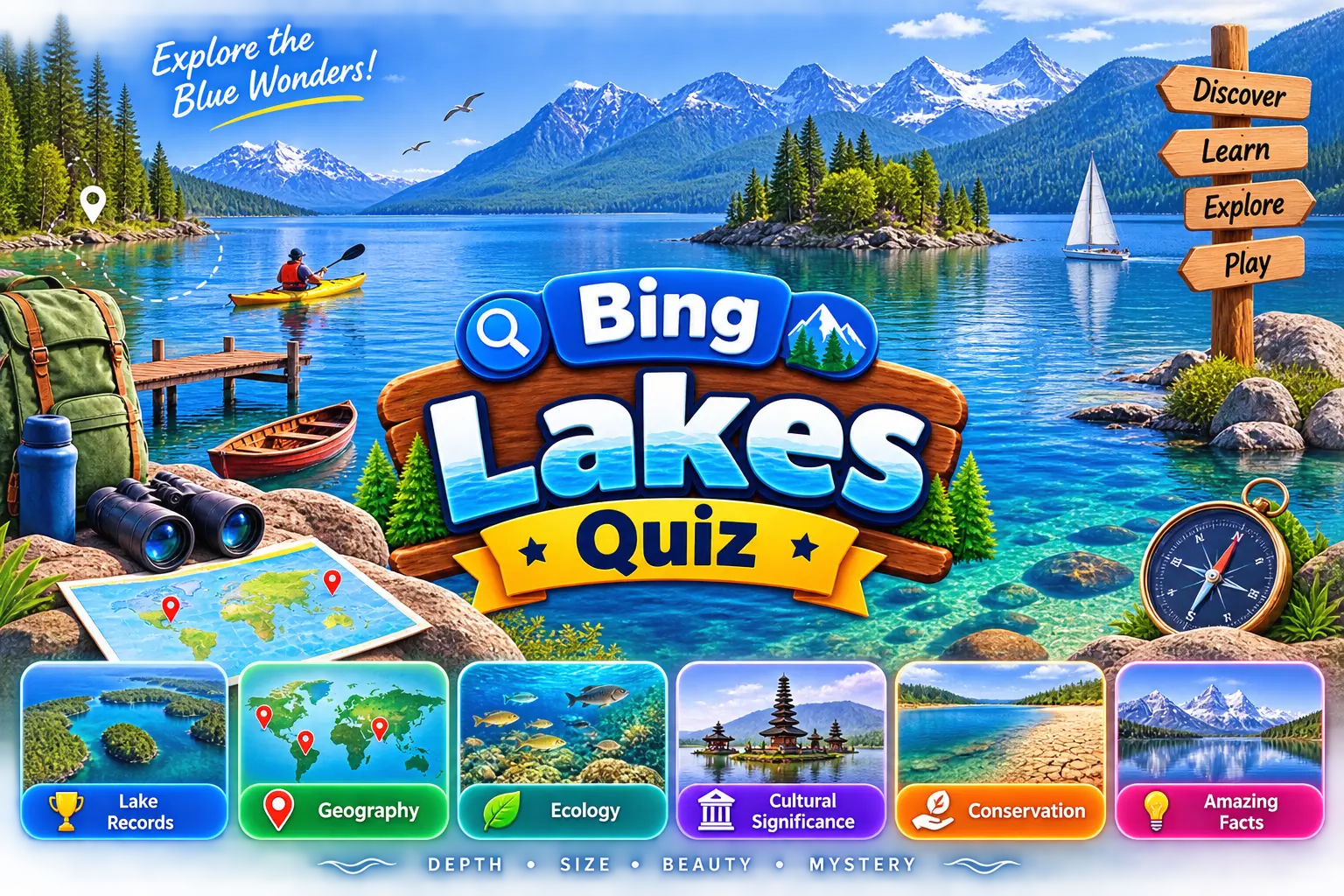
The Bing Lakes Quiz on BingQuiz.org is a trivia challenge dedicated to the world's most significant lakes. Eight questions cover lake records, geography, ecology, cultural significance, conservation, and the surprising facts that make lake trivia genuinely interesting to anyone who has encountered a lake-themed quiz on the Bing homepage.
The Bing Lakes Quiz goes beyond the standard record questions. Most players know Lake Baikal is the deepest lake and that the Caspian Sea is technically a lake. The quiz tests what lies underneath that.
The word largest gives three different answers depending on whether you measure by area, volume, or freshwater content. Lake Baikal holds 20 percent of the world's unfrozen fresh water. The Dead Sea shrinks by approximately one metre every year. Lake Victoria supports 40 million people across three countries.
Every answer in the Bing Lakes Quiz is researched and verified by the BingQuiz team before going live. The quiz is static and evergreen. The same eight questions are always available, always playable, with full explanations after every submission.
HOW TO PLAY
How to Play the Bing Lakes Quiz
A quick, three-step format: dive in, navigate the depths, see where you surface.
-
01
Dive In
Hit the Start Quiz button on the Bing Lakes Quiz. The 80 second timer kicks in, and your first question appears immediately.
-
02
Navigate the Depths
Eight questions appear one at a time on the Famous Lakes Quiz. Go back to any earlier question if you want to change an answer before the timer runs out.
-
03
See Where You Surface
Once you submit, your score, rank, and a detailed explanation for every answer appear on the same page of the World Lakes Trivia Quiz on BingQuiz.
WHAT IT COVERS
What the Bing Lakes Quiz Covers
The Bing Lakes Quiz covers six areas of lake knowledge across its eight questions. Here is what to expect in each one before you play.
1
Lake Records
Questions about the record-holding lakes that define global geography. Largest, deepest, highest, saltiest, and lowest. The key thing to know before playing: largest has three different correct answers depending on how you measure it. Largest by total surface area is the Caspian Sea. Largest freshwater lake by surface area is Lake Superior. Largest by volume of fresh water is Lake Baikal. The quiz uses precise wording so the measurement always matches the answer.
2
Lake Geography
Questions about where famous lakes are located, which countries share their borders, and which continent they sit on. Knowing which African countries share Lake Victoria, which South American countries border Lake Titicaca, and where Crater Lake sits covers most of what this category tests.
3
Lake Ecology
Questions about lakes as living ecosystems. What makes each lake biologically unique and how freshwater ecosystems function. Lake Baikal alone contains more than 3,500 unique species found nowhere else on Earth. This category connects geography to natural science.
4
Famous Lakes
Questions about culturally significant lakes that appear in literature, film, tourism, and popular culture. Loch Ness, Lake Como, Crater Lake, Lake Geneva, Lake Tahoe. Players who follow travel content or European geography will recognise most names here.
5
Lakes at Risk
Questions about conservation challenges facing the world's freshwater lakes. The Dead Sea shrinks by approximately one metre per year. The Aral Sea has lost more than 90 percent of its volume since the 1960s. This category connects lake geography to real world environmental change.
6
Surprising Lake Facts
Questions about the definitional edge cases that make lake trivia genuinely interesting. The Caspian Sea is classified as a lake despite its name. The Dead Sea is a lake, not a sea. Lake Baikal holds two separate world records simultaneously. Getting these distinctions right is what separates a Mastermind from a Wanderer on the Bing Lakes Quiz.
At the end of every Bing Lakes Quiz, all eight correct answers are revealed with a short explanation. Every player walks away from the Freshwater Quiz knowing something new about the world's most significant bodies of water.
FACTS MOST PEOPLE NEVER KNEW
The World's Greatest Lakes: Facts Most People Never Knew
Lakes are geography's quiet record-holders. The largest lake is called a sea. The deepest lake holds a fifth of the world's fresh water. The lowest lake is sinking further every year. Here are the facts that go beyond the textbook answers.
1
The Caspian Sea is actually a lake
Despite its name, size, and saltwater content, the Caspian Sea is classified as a lake because it is entirely landlocked with no natural connection to any ocean. It covers approximately 371,000 square kilometres, making it the largest lake on Earth by surface area.
2
Lake Baikal holds two world records simultaneously
It is the deepest lake on Earth at 1,642 metres and the largest freshwater lake by volume, containing approximately 20 percent of the world's unfrozen surface fresh water. It is also one of the oldest lakes in the world at an estimated 25 to 30 million years old.
3
Lake Superior is the largest freshwater lake by surface area
Covering approximately 82,000 square kilometres, it is the largest of the five Great Lakes of North America and the largest freshwater lake in the world when measured by surface area rather than volume.
4
Lake Titicaca sits at 3,812 metres above sea level
Located on the border between Peru and Bolivia, it is the highest navigable lake in the world. It covers approximately 8,372 square kilometres and is home to several inhabited islands including Isla del Sol, considered sacred in Inca mythology.
5
The Dead Sea is the lowest point on Earth's surface
Sitting approximately 430 metres below sea level on the border between Israel and Jordan, the Dead Sea is nearly ten times saltier than the ocean. Its extreme salinity means almost nothing can survive in it, giving it the name that has defined it for centuries.
6
Lake Baikal contains more unique species than any other lake on Earth
Over 3,500 plant and animal species have been identified in and around Lake Baikal, with roughly two thirds found nowhere else in the world. This includes the Baikal seal, the only freshwater seal species on Earth, which evolved in complete isolation from its marine relatives.
7
Lake Victoria supports approximately 40 million people
Shared between Tanzania, Uganda, and Kenya, Lake Victoria is the largest lake in Africa by surface area and the world's largest tropical lake. It is the primary source of the White Nile and supports one of the most significant freshwater fishing industries on the planet.
8
Less than 3 percent of Earth's water is fresh water
Of that tiny fraction, the vast majority is locked in glaciers and ice caps. Lakes and rivers together hold less than 0.3 percent of all water on Earth. Lake Baikal alone contains more fresh water than all five of North America's Great Lakes combined.
9
The Dead Sea is shrinking by approximately one metre every year
Water diversion from the Jordan River, which feeds the Dead Sea, has reduced inflow dramatically over the past century. The lake has lost roughly a third of its surface area since the 1960s and continues to shrink at an accelerating rate.
10
The Aral Sea has almost entirely disappeared
Once one of the four largest lakes in the world, the Aral Sea in Central Asia has lost more than 90 percent of its volume since the 1960s following Soviet-era irrigation projects that diverted its two main feeder rivers. What remains is a fraction of the original lake divided into separate smaller bodies of water. It is considered one of the worst environmental disasters in human history.
UNDERSTANDING YOUR RANK
Understanding your rank on the Bing Lakes Quiz
Every player receives a rank after submitting the Bing Lakes Quiz. Since the quiz is static and evergreen, logged-in players are credited once for completing it — the same eight questions are always there to revisit and learn from, any time.
Wanderer
0-1/8A score of 0-1 places you in the Wanderer tier.
The Bing Lakes Quiz spans six areas of lake knowledge within an 80 second timer, so a low score here just means there is a lot left to learn — and eight new facts waiting either way.

Curious
2-3/8A score of 2-3 places you in the Curious tier.
Getting a couple of questions right on lake records, geography, or ecology is a genuine result and marks the starting point of the rank ladder on the Bing Lakes Quiz.

Informed
4-5/8A score of 4-5 places you in the Informed tier.
Answering roughly half of the 8 questions correctly shows a solid working knowledge of the world's lakes beyond Lake Baikal and the Caspian Sea.

Sharp
6/8A score of 6 places you in the Sharp tier.
Scoring above the midpoint of the Bing Lakes Quiz means your knowledge is holding up consistently across records, geography, ecology, famous lakes, lakes at risk, and surprising facts.
Brilliant
7/8A score of 7 places you in the Brilliant tier.
This is a strong performance on the Famous Lakes Quiz, with only one question separating this rank from a perfect score.

Mastermind
8/8A perfect score of 8 earns the Mastermind rank, the highest tier on the Bing Lakes Quiz.
Reaching Mastermind means every question landed correctly across lake records, geography, ecology, famous lakes, lakes at risk, and surprising lake facts.
Reaching Mastermind on the Bing Lakes Quiz means answering all 8 questions correctly across six areas of lake knowledge within 80 seconds. Only a small percentage of players achieve a perfect score.
0% of players reached Mastermind since it went live.
FAQ
Frequently asked questions
Find answers to the most common questions about the Bing Lakes Quiz. Everything you need to know before you start playing.
Does the Bing Lakes Quiz cover lakes from all continents?
Yes. The quiz covers lakes from across the globe, including lakes in Asia, Africa, North America, South America, and Europe. No single continent dominates the question set.
Does the quiz cover the Great Lakes of North America?
Yes. The Great Lakes feature in the Lake Records and Lake Geography categories. Lake Superior in particular appears as one of the world's most significant freshwater lakes by surface area.
Is the Bing Lakes Quiz suitable for students?
Yes. All questions are factual, age appropriate, and suitable for players of all ages. The quiz works well as a learning tool for students studying physical geography, freshwater ecosystems, or world records.